
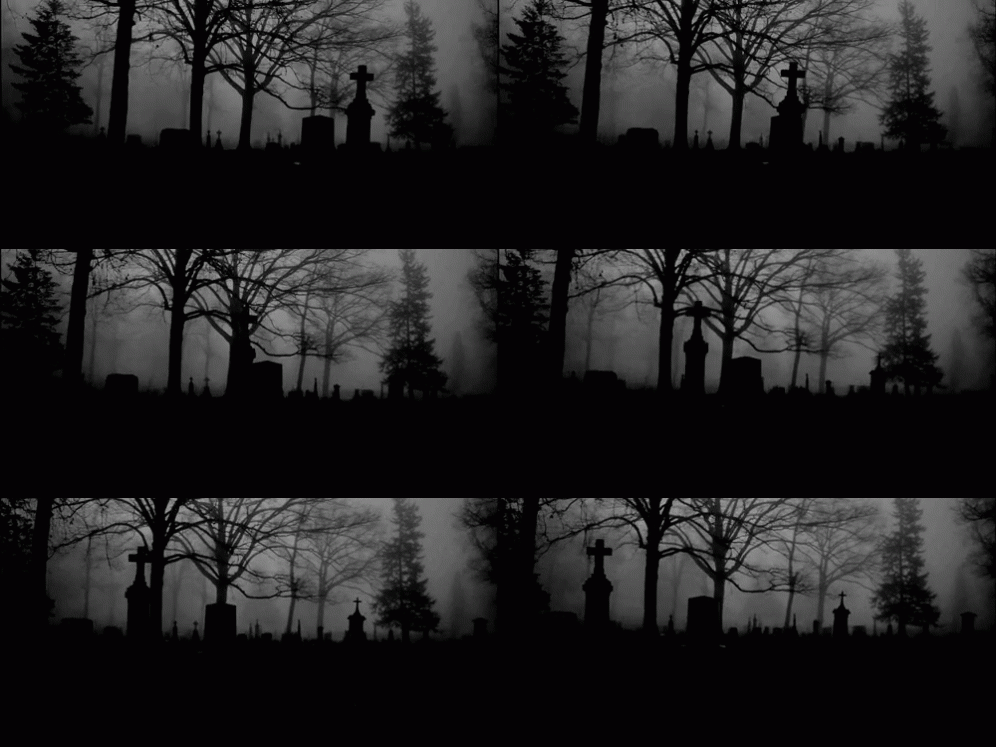
I stumble through the streets while Mama trails behind, preventing the train of my dress from dragging through the dirt and leaves. Her breathe is loud in my ears as we progress. She is struggling to keep her balance.
There are no horses or mules to convey us to the churchyard.
They were slaughtered for meat ages ago.
Mama pleaded to have the ceremony at our home. Walking such a distance is a burden when one can barely stand without swooning.
“No,” the wise woman said. “The graveyard. It must be done in the graveyard. The spirits will accept no less.”
Long-faced villagers watch solemnly outside their homes as we pass; the ones too weak to make the pilgrimage to the church grounds to attend the ceremony. All eyes are on me and my wedding gown. I should be proud. I was chosen out of everyone. Yet I cannot let my heart be glad of it. There is not much pride in being the ugliest girl in the village.
The procession is eerily quiet. No birdsong. No cats prowling the streets. Children are shuttered indoors for fear of catching sickness or worse. It is not uncommon these days for unattended children to go missing.
I want to break this heavy silence, but I don’t dare.
I know what Mama is thinking. This dress—worn by Mama on her wedding day and her mother and her mother’s mother— should have been worn by my comely older sister. But Hanna is dead and now it is mine. Mama pinned it in half a dozen places to fit my skeletal form and yet even now it hangs from me like a cloak. Perhaps I look beautiful. With the veil over my face, no one can see the mottled flesh where the fire ravaged my cheek as a child.
I long to walk faster to get the deed over and done with, but I’m too weak to move at anything faster than a shuffle. It has been two days since I last ate and my head is swimming. Tears prick my eyes at the memory of our last meal.
“Black cats are bad luck anyway,” Mama said after we had picked the cat’s bones clean of meat.
We promised Hanna we wouldn’t eat him.
But we were so hungry.
Above the clouds are rolling forth, blotting out the sun. Villagers turn their eyes upwards, murmuring softly For the first time in an age, something other than misery crosses their faces. They are afraid to hope, but hope is all that remains to us. Everything else has rotten away.
“The spirits are pleased,” Mama whispers breathlessly, echoing all our thoughts. “The storm is coming.”
In another life my groom would be waiting for me at the alter, backlit by the stained glass windows adorning our pretty church. In reality our chapel is a hastily erected canopy, listing precariously in the growing breeze.
I spy the priest stooped over his stained bible, leafing through its worn pages with tremulous hands. He is the second priest we have had since the famine. The other two died of sickness after performing the last rites for two invalids.
Another figure sits slouched in a wooden chair, the shadow of the canopy enveloping them in darkness.
My intended.
I swallow. I try to recollect his name but my mind is in tatters.
Mama drops my train and steps away from me to take her place among to scant crowd. I chance a look over my shoulder at her. Her face is solemn with not even a ghost of a smile. Her eyes are watery and pitiful like a child awaiting a scolding.
I want to provide words of comfort, but I fear I might be sick if I try. Instead, I soberly make my way under the canopy to stand opposite the man who is soon to be my husband.
The blood drains from my face. His flesh is gray. Hair that might have once been flaxen, now resembles dead grass. Dim sunken eyes regard me vacantly as a fly wheels around him, droning.
I look to the graveyard. Hundreds perhaps thousands of ancient stones weathered and cracked with age stretch out before me.
Will they be pleased with the ceremony?
The wind slams into us, sending the canopy tassels rattling. I think I hear a whisper.
The priest reads from his Bible, but I can’t make out the words. They are drowned out by the drumming of blood in my ears. I stare at my husband. I should take his hands, but I’m too frightened. I know they will be cold as ice. A fly lands on his hair and crawls across his forehead and yet he doesn’t stir. Is he even alive?
“Do you, Laszlo, take Anna to be your lawfully wedded wife?” the priest asks.
My beloved’s mouth opens just the smallest bit like an infant anticipating its mother’s milk. A wheezing too quiet to hear over the wind groans from his mouth. The attended are silent. My mouth is dry. Would the spirits accept this answer?
Another wheezing groan. I throw a look over my shoulder at the priest. “He said ‘I do,’” I say.
“And do you, Anna, take Laszlo to be—”
“I do,” I choke. A blush spreads across my cheeks as I realize I have spoken too soon. “I do,” I say again, this time more timidly.
“You may kiss the bride,” the priest says.
I lift the veil away from my face, knowing Laszlo is incapable of doing so himself and bend down. Just as my lips are about to press against his, I see a scarlet splotch just near his neckline. My heart leaps into my throat. He has the sickness. It is identical to the sore my sister developed days before she died.
My stomach lurches, but I must complete the ceremony. I must do what is asked of me.
My lips barely brush his. No one claps. All attending are as silent as the graves that surround us.
“Spirits,” the priest says, “we have bound these two gentle souls together in holy matrimony. Now both shall drink the blessed wine.”
A spindly woman, stooped and adorned with what might have once been a beautiful crimson scarf appears at my side, holding a chalice full of liquid, red as blood. It takes me a moment to recognize her as Madame herself; the architect of this ceremony. No one knows how old she truly is. Only that she hails from a land few have heard of and her knowledge is as revered as the holy pages of the priest’s sacred book. It was she who had singled me out as the bride for the wedding, our last appeal to the spirits.
I take the cup from her and gently place the rim of the chalice to my husband’s parted lips. I must use my other hand to lift his chin so liquid won’t dribble down his threadbare shirt. How shall I attend to such a husband? One who cannot walk or eat or even speak under his own power?
“I pronounce you husband and wife.”
The crowd is silent, waiting for the spirits to give their ascent. A moment passes. The next. Every hair on our bodies prickles in anticipation so strong we could swoon from it.
A bolt of lightning illuminates from behind a cloud. A powerful report. Thunder. My mouth opens in awe as small pellets of rain drop languidly from the sky.
The attendance erupts in raptures. Some weep. Others cheer. It has worked.
My mouth gapes in a wide smile. I turn to gaze upon my husband to share in this moment with him. However, he continues to look blankly at the headstones, a thin line of saliva flowing from the corner of his mouth.
“Laszlo,” I say gently. His inert body shudders, twitches. A hoarse gagging noise. Foam oozes from his lips, falling to his lap. My lower lip trembles and my stomach drops.
“Help!” I cry. “He’s choking!”
But no one is listening to my plea. They have all taken to dancing and jubilation, their bodies numb to anything but their own joy. I stagger into the minister. It is the hunger. I have been standing too long. That must be it. “He…” the words clot my throat, choking me.
I can’t breathe. I gasp, but no breath will enter my lungs.
I sink to the ground, my abdomen burning. These are not hunger pains. I look towards Laszlo. He is slumped in his chair. The fly is crawling on his eyes— his unblinking eyes— as foam drips from his lap. I want to scream, but I cannot get the breath. Bile pushes up my throat and my body quakes. I feel cold. So cold.
A voice speaks to me from the abyss. It sounds like Mama’s, soft and hoarse. “Thank you, Anna. Sleep well.”
Happy Halloween!

 The Crooked Pen
A well-told tale.
LikeLiked by 1 person
Thank you! And thanks for reading 🙂
LikeLike